Mr Luck Payment Methods and Deposit Limits
 Available in GB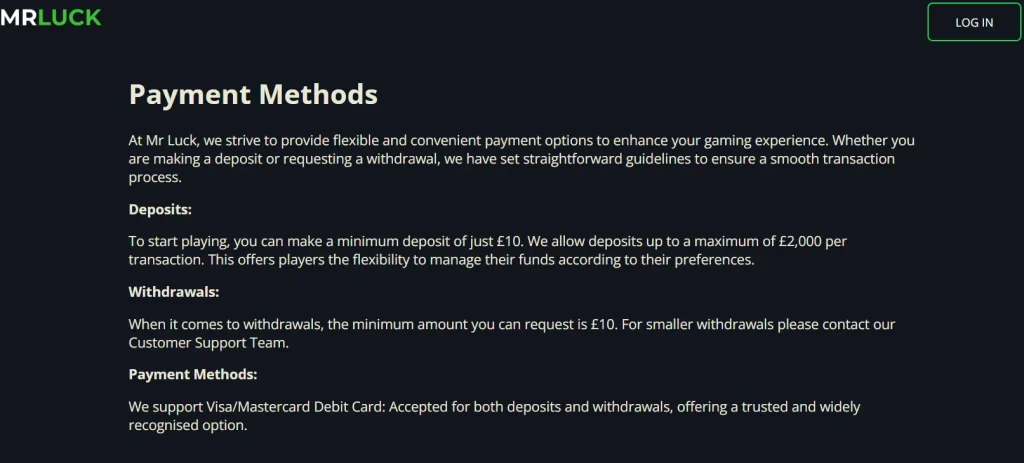
Cashier evidence guide
For UK players, the current Mr Luck payment page gives a clear official baseline: the minimum deposit is £10, the maximum deposit is £2,000 per transaction, and Visa/Mastercard Debit Card is explicitly listed for both deposits and withdrawals. Other payment names appear in broader marketing and app-store material, but the live cashier information does not currently confirm them in the same way. For that reason, this page treats debit cards as verified and does not promise PayPal, Skrill, Trustly, Apple Pay or another wallet as a current cashier option.
Table of Contents
- Current verified Mr Luck deposit limits
- Why this guide only locks in debit-card support
- Payment ownership rules matter as much as the method
- Debit cards in the UK context
- Financial-limit prompts before the first deposit
- How deposits connect to withdrawals
- A practical deposit checklist
- How to compare a cashier method without overvaluing convenience
- Questions about Mr Luck deposits
- What the verified Mr Luck cashier setup means for UK deposits
- Mr Luck Payment Methods and Deposit Limits
Current verified Mr Luck deposit limits
| Cashier detail | Current verified position | Practical reading |
|---|---|---|
| Minimum deposit | £10 | You need at least £10 for a standard deposit. |
| Maximum deposit per transaction | £2,000 | The published ceiling applies to one deposit transaction; it is not a recommendation or spending target. |
| Verified card method | Visa/Mastercard Debit Card | The official payment page explicitly lists debit cards for deposits and withdrawals. |
| Credit funding | Prohibited | Mr Luck’s current terms prohibit credit cards and other credit facilities for funding the account. |
| Third-party funding | Prohibited | The payment method must belong to the account holder. |
The £10 and £2,000 figures answer two different questions. The first tells you the smallest standard deposit Mr Luck currently publishes. The second is a transaction cap, not a sensible default bankroll. A safer starting point is to decide a personal budget independently of the cashier’s maximum.
Why this guide only locks in debit-card support
Payment lists are easy to overstate. Mr Luck’s Android listing mentions a broader set of familiar methods, while the current official payment page specifically names Visa/Mastercard Debit Card. When two surfaces have different levels of specificity, the cashier page is the stronger source for a claim about what you can actually select for a transaction today.
That is why this page does not convert a marketing mention of Apple Pay, PayPal or another wallet into a guaranteed cashier option. A method can appear in app copy, footer imagery or a third-party review and still be unavailable to a particular account, device, transaction type or current cashier configuration. The useful distinction is between marketed payment names and currently verified cashier support.
This evidence-first approach may produce a shorter payment list than some comparison pages, but it is more actionable. It tells you what the operator’s payment page actually commits to rather than padding the page with every UK payment brand seen elsewhere.
Payment ownership rules matter as much as the method
Mr Luck’s current terms say payment methods used for deposits and withdrawals must be valid and belong to the account holder. They explicitly prohibit another person’s card, bank account, e-wallet or digital payment account, as well as business or corporate payment accounts and credit facilities. Permission from the other person does not turn a third-party payment method into an allowed one.
For digital wallets, the ownership rule extends to the underlying funding method. In other words, using a wallet in your own name does not solve the problem if the linked card or account belongs to somebody else. The operator can carry out checks on payment-method ownership and source of funds.
The practical implication is straightforward: use a payment route in your own name and keep the account details consistent. Mismatched names create avoidable friction around verification and can lead to transaction restrictions. The Mr Luck registration covers the wider account setup, while payout mechanics belong in the separate Mr Luck withdrawals guide.
Debit cards in the UK context
UK online-gambling payment discussions commonly cover debit cards, bank transfers, e-wallets and mobile wallets. That market context is useful for understanding what players may be accustomed to, but it should not be confused with Mr Luck’s own live support list. At the operator level, the current payment page gives the strongest confirmation for Visa/Mastercard Debit Card.
Credit cards are a different matter. Mr Luck’s own terms prohibit credit-card and other credit-facility funding, so a player should not interpret the Visa or Mastercard brand name as permission to use any card carrying that logo. The verified wording is specifically about debit cards.
This distinction is especially important on mobile, where a familiar wallet logo can make the underlying funding source less visible. The account-holder and no-credit rules still matter regardless of the interface used to initiate the payment.
Financial-limit prompts before the first deposit
UK Gambling Commission rules require remote gambling businesses to prompt new customers to set a financial limit as part of registration or at the point of the first deposit. The rule has applied since 31 October 2025. The purpose is to make budgeting tools visible before money starts moving rather than burying them after play begins.
Mr Luck also provides deposit-limit controls in its safer-gambling area. The payment page’s £2,000 per-transaction maximum should therefore be read as an operator transaction boundary, while a personal financial limit is a separate player-control decision. Those two numbers serve different functions and should not be treated as interchangeable.
A useful habit is to set the personal limit from your own disposable gambling budget before looking at the cashier maximum. The system’s ability to accept a larger transaction is not evidence that a larger transaction is affordable.
How deposits connect to withdrawals
The official payment page states that Visa/Mastercard Debit Card can be used for both deposits and withdrawals, but detailed cashout questions deserve their own treatment. Processing times, method-specific restrictions and other payout mechanics are more sensitive than the basic deposit information and can change independently.
For that reason, this page stops at the funding side and sends cashout questions to the withdrawal guide. It avoids inventing fees or promising a processing speed that the current deposit evidence does not support. If your main decision is how quickly money can leave the account, the withdrawal page is the more relevant next read.
The broader Mr Luck UK review puts payments alongside licensing, games and account usability. For licensing context specifically, see the Mr Luck licence.
A practical deposit checklist
- Choose the budget first. Decide what you can afford to lose before opening the cashier.
- Confirm the live method. Treat the logged-in cashier as the final check for any wallet or alternative payment route.
- Use your own funding source. The card, account or wallet must belong to you, including the underlying method used by a digital wallet.
- Do not use credit. Mr Luck’s current terms prohibit credit cards and other credit facilities.
- Check any promotion separately. A bonus may have its own qualifying amount or game requirement. The Mr Luck bonus guide explains the current casino welcome structure.
How to compare a cashier method without overvaluing convenience
A payment method is useful only if it works for the whole transaction cycle you need. Deposit convenience matters, but so do ownership checks, withdrawal compatibility and the likelihood that the operator will ask for verification before releasing funds. The official Mr Luck payment page helps here because it confirms debit-card support for both deposits and withdrawals, giving that route a clearer two-way status than methods mentioned only in broader marketing copy.
Speed should not be assumed from a familiar logo. This page deliberately avoids assigning instant, same-day or multi-day processing claims to any method because the current deposit evidence does not support those timings. If payout speed is your deciding factor, use the dedicated withdrawal guide rather than inferring it from the deposit screen.
Fees require the same discipline. A payment page that names a method does not automatically prove that every transaction is fee-free, and a third-party review can become stale when processors change. The useful current facts are therefore the published deposit thresholds and the officially listed debit-card route. Everything else should be checked inside the live cashier before moving money.
This evidence hierarchy also prevents a common mistake: treating the longest payment list as the best cashier. For many UK users, a shorter list that clearly supports a personally owned debit card may be more practical than a long list of wallets whose current availability is uncertain. The better comparison is whether the method you actually use is supported, not how many logos can be collected into a table. That makes the live cashier the final practical checkpoint before every deposit.
Questions about Mr Luck deposits
What is the minimum deposit at Mr Luck?
The current official payment page states a £10 minimum deposit.
What is the maximum Mr Luck deposit?
Mr Luck currently states a maximum of £2,000 per deposit transaction. That is a cashier limit, not a recommended gambling budget.
Does Mr Luck accept PayPal or Apple Pay?
Those names appear in broader marketing material, but the current official payment page specifically confirms Visa/Mastercard Debit Card. This guide therefore does not guarantee PayPal, Apple Pay or other wallets as current cashier methods.
Can I use somebody else’s card?
No. Mr Luck’s current terms prohibit third-party payment methods, even if the other person has given permission.
Can I use a credit card?
No. The current terms prohibit credit cards and other credit facilities for account funding.
What the verified Mr Luck cashier setup means for UK deposits
The dependable current baseline is narrow but clear: £10 minimum deposit, £2,000 maximum per transaction, and Visa/Mastercard Debit Card confirmed by the operator’s payment page. For alternative wallets, the logged-in cashier is a better test than a marketing list. The ownership rules are equally important: use your own payment source and no credit facility. For a UK player, that combination makes the practical deposit decision more about verified access and personal limits than about chasing the longest possible payment-method list.