Mr Luck KYC and Verification in the UK
 Available in GB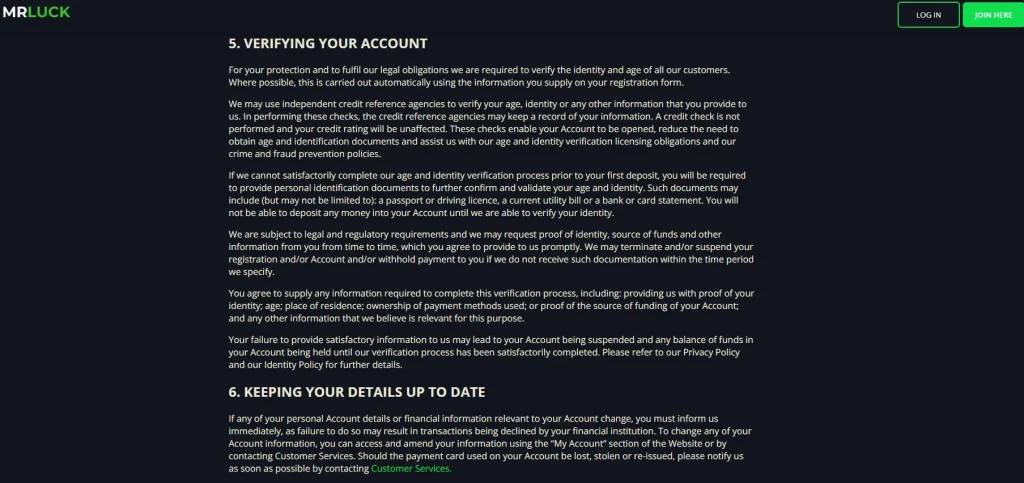
Identity and account checks
Mr Luck verifies the identity and age of its customers. Where possible, this happens automatically using the information entered during registration. If those checks cannot be completed satisfactorily before the first deposit, the current terms say Mr Luck can request identification such as a passport or driving licence plus proof of address such as a current utility bill or bank/card statement. Further checks can include proof of payment-method ownership and source of funds. Those examples are not a fixed document list for every customer, and Mr Luck does not publish a universal KYC processing time in the current terms.
Table of Contents
- What Mr Luck verifies first
- When documents can be requested before the first deposit
- Identity documents and address evidence are different jobs
- Payment ownership checks
- What source-of-funds checks mean here
- KYC and withdrawals: what the UKGC rule actually says
- What happens if verification is incomplete?
- A preparation checklist that stays within the current terms
- Why the Mr Luck licence matters for verification
- How to reduce avoidable verification delays at Mr Luck
- Recommend
What Mr Luck verifies first
The baseline check is identity and age. Mr Luck’s terms say it verifies all customers and, where possible, carries this out automatically from the information supplied on the registration form. The UK Gambling Commission requires remote operators to verify, at minimum, a customer’s name, address and date of birth before allowing that customer to gamble.
This creates two distinct layers. The first is the core information every customer supplies and that the operator must verify. The second is documentary or financial evidence requested when automatic checks are insufficient or when additional legal and regulatory checks are required. Separating those layers helps avoid the common misconception that every player automatically has to upload the same passport, bank statement and source-of-funds pack.
If you are still at the signup stage, the Mr Luck registration explains how residency, accurate personal data, account ownership and the first-deposit limit prompt fit together before deeper KYC questions arise.
When documents can be requested before the first deposit
Mr Luck’s current terms are unusually specific about what happens if automatic age and identity checks do not complete satisfactorily before the first deposit. In that situation, the customer is required to provide personal identification documents before depositing is enabled.
The terms give examples that can include a passport or driving licence for identity and a current utility bill or bank/card statement for address evidence. The wording is explicitly non-exhaustive. These are examples of documents the operator can request, not a promise that every customer will need all of them or that these are the only acceptable documents in every case.
The best preparation is therefore not to upload a bundle of documents pre-emptively. Keep your registration data accurate, make sure you can access current identity and address records if requested, and follow the specific request shown in your account. Sending unrelated or expired evidence can create more work rather than less.
Identity documents and address evidence are different jobs
| Evidence type | Current Mr Luck terms give these examples | Purpose |
|---|---|---|
| Identity | Passport or driving licence | Helps confirm who you are and supports age verification. |
| Address | Current utility bill or bank/card statement | Helps validate the residential address linked to the account. |
| Payment ownership | No universal fixed document example stated | Shows that the payment method used belongs to the account holder. |
| Source of funds | No universal fixed document example stated | Supports checks on where gambling funds come from when the operator needs that information. |
This distinction is practical. A passport can prove identity but normally does not show a current residential address. A bank statement can show an address and may relate to financial checks, but it is not automatically a substitute for every identity requirement. The operator’s request should tell you which question it is trying to resolve.
Payment ownership checks
Mr Luck’s payment rules say that deposit and withdrawal methods must belong to the customer. Another person’s debit card, bank account, e-wallet or other payment method is prohibited even with permission. Where a digital wallet or payment service is used, both the wallet and the underlying payment method must belong to the account holder.
That is why KYC and payments overlap. The operator may ask for evidence that a payment method is yours, particularly where ownership is not sufficiently clear from existing records. A payment-ownership check is not the same as a basic age check, but both can be part of keeping the account identity and the money entering or leaving it consistent.
The practical way to reduce this risk is to use your own supported payment method from the first deposit onward. The Mr Luck withdrawals explains how verification and payment ownership can affect cashing out.
What source-of-funds checks mean here
Mr Luck’s terms say the operator may request proof of source of funds and other information from time to time. The anti-money-laundering section also allows additional details or documentation to verify identity, address, ownership of payment methods and funds used for deposits or withdrawals.
The important boundary is that the current terms do not give one universal source-of-funds document pack that applies to every customer. What is requested can depend on the reason for the check and the information already available to the operator. For that reason, this guide does not invent a fixed checklist such as salary slips plus bank statements plus tax returns for everyone.
If a source-of-funds request appears, read the request literally and provide evidence that addresses the stated question. If it is unclear, ask support what period, account or transaction the evidence needs to cover before sending documents. That is more reliable than copying a checklist from another casino, because operators can structure their checks differently while still working toward the same regulatory objectives.
KYC and withdrawals: what the UKGC rule actually says
The UK Gambling Commission requires operators to obtain and verify core identity information before gambling. It also states that a withdrawal request must not trigger a demand for additional information that the operator could reasonably have requested earlier. That rule was introduced specifically to reduce the practice of delaying routine identity checks until a customer tried to cash out.
It does not mean that no further checks can ever happen around a withdrawal. The licence condition expressly allows operators to seek information they are legally required to obtain at that time. Mr Luck’s terms likewise allow verification, gameplay, payment-ownership and source-of-funds checks where relevant, and payment of prizes can depend on successful completion of required verification processes.
The useful distinction is timing and reason. Basic name, address and date-of-birth verification belongs before gambling. A later check should have a genuine reason rather than simply being a routine identity step postponed until withdrawal.
What happens if verification is incomplete?
Mr Luck’s terms say that if automatic verification cannot be completed before the first deposit, you will not be able to deposit until identity verification is completed. They also allow the operator to suspend an account or transactions while required checks remain outstanding, and balances can be held until the verification process is satisfactorily completed.
That is a stronger reason to respond to requests promptly than any promise about a specific turnaround time. The current terms do not provide one universal KYC processing time, so this page does not quote hours or days. The duration can depend on what was requested, whether the evidence is readable and current, and whether further clarification is needed.
If you are waiting on a check, avoid submitting multiple inconsistent versions of the same document. Use the account’s stated upload or contact route and keep a record of what you sent. If a request is unclear, Mr Luck offers live chat and email support.
A preparation checklist that stays within the current terms
- Use your legal name, current residential address and correct date of birth when registering.
- Be ready to show a passport or driving licence if documentary identity evidence is requested.
- Keep a current utility bill or bank/card statement available if proof of address is requested.
- Use only payment methods that belong to you.
- Be prepared to establish ownership of a payment method if Mr Luck asks for it.
- Respond to a source-of-funds request with the evidence the operator actually specifies rather than assuming one standard document set.
- Do not rely on an exact processing-time promise; none is stated as a universal KYC timeframe in the current terms.
This checklist is deliberately narrower than many generic casino KYC guides. It reflects examples and requirements that can be tied directly to the current Mr Luck terms and UKGC rules, rather than adding documents that might be common elsewhere but are not supported here as universal requirements.
Why the Mr Luck licence matters for verification
Mr Luck is operated by Jupiter Gaming Limited under a UK Gambling Commission remote casino licence. The UKGC identity condition therefore applies to the regulated account journey described on this page. The licence itself does not tell you which exact documents your individual account will be asked for, but it explains why age and identity controls are built into access to gambling rather than treated as optional back-office checks.
For the operator record and current licence status, use the dedicated Mr Luck licence. For a broader view of the casino rather than compliance mechanics, return to the Mr Luck UK review.
How to reduce avoidable verification delays at Mr Luck
Keep the identity on the account, the address you provide and the ownership of your payment method consistent from the start. If automatic checks fail, respond to the exact document request with current, readable evidence rather than assuming a universal checklist. Treat source-of-funds or payment-ownership questions as separate checks with separate purposes, and ask support for clarification when the requested scope is unclear. Most importantly, do not plan around a fixed KYC completion time: the current terms establish the checks and examples, but not one guaranteed processing window for every account.